In Media, Ideology refers to a system of belief/political system that is constructed and presented by media text. For example, a news story about a strike; It can be perceived or implies an underlying ideology about who is right.
Ideology is a very imprtant concept as it underpins the contruction of virtually any media text. This will aldways have an ideology which communicates expliciltly/implicitly to an audience. For example, a newspaper will usually have an explicit political ideology but may have an implicit ideology as well. A film may not appear an ideology but may construct a strong one for its audience. For a magazine, it could have an Ideology to do with a particular demographic, lifestyle or political system.
Friday, 27 January 2012

Thursday, 26 January 2012
Researching Music Magazines
The next part of my preliminary task was to research two current music magazines, this will help my understanding to what the layout of these are like. Below are two examples:


Here, they both share many similarities in terms of features. Below is a mock-up of them, their key features and terms.
 These magazines use features such as the main background image which is all over the cover, smaller features of the magazine which are at the bottom of the cover so that the main image is not completely covered.
What does this suggest about what editors find important in terms of their cover make-up?
From here, the importance of cover make-up shows that because there is very little if any used, it shows the artist to be more 'true' in terms of emotion or the statement they are trying to justify.
How have pugs/banners/puffs etc been used to help sell the magazine?
Look at the use of Semiotics. Which colours and signs have been used, and what do they suggest? How do they help to sell the magazine?
Can you apply any of the theories you have learned (such as feminism/male gaze) to this cover? If so, comment on it.


Here, they both share many similarities in terms of features. Below is a mock-up of them, their key features and terms.

What does this suggest about what editors find important in terms of their cover make-up?
From here, the importance of cover make-up shows that because there is very little if any used, it shows the artist to be more 'true' in terms of emotion or the statement they are trying to justify.
How have pugs/banners/puffs etc been used to help sell the magazine?
Look at the use of Semiotics. Which colours and signs have been used, and what do they suggest? How do they help to sell the magazine?
Can you apply any of the theories you have learned (such as feminism/male gaze) to this cover? If so, comment on it.
Wednesday, 25 January 2012
Rule of Thirds
The Rule of thirds is a guideline which applies to the process of composing photographs or images. The guidline states that any image should be framed with only 2/3rds of the main object in focus or view. It also states that the main object should never be in the centre of the image so it looks more natural.

(an example of a picture without Rule of Thirds applied, and then one with Rule of Thirds.)
Tuesday, 24 January 2012
Preliminary Task: School Magazine Analysis
School Magazines
For this task, I have been asked to analyse a School magazine. For this I have chosen our own school's magazine to annotate the particular features which are seen in this; Normally in school magazines you would find:
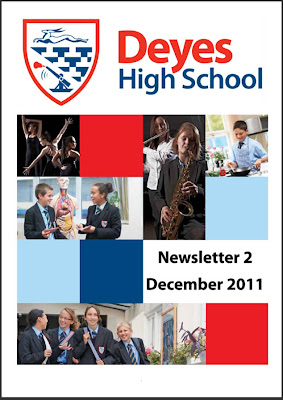

For this task, I have been asked to analyse a School magazine. For this I have chosen our own school's magazine to annotate the particular features which are seen in this; Normally in school magazines you would find:
- Informative text. (Generally about the school or current events)
- Pictures showing activities that are related to the school.
- Informal/Formal text depending if the magazine is aimed at the students or teachers/guardians.
- School Logo/House Style of the school represents synergy between the school and the magazine.

This is the front page of our school magazine. It includes the School Logo, and the same House Style colours to our uniform. This fits the typical layout of a school magazine.

This is the double-page spread of our school. The text used here is formal not only in font type but in the language used, this would be directed more towards parents/guardians as it talks about the press of students, also that it talks very informatively about the school.
Semiotics
Semiotics is where signs are used to stand for something other than what it is. For example, the colour green can represent envy or greed.
There are two main theories in Semiotics, "de Saussure's Dyadic Semiotic System, where there is the "Signifier" and a "Signified". The "Signifier" is what is seen and the "Signified" is what is implied or meant. The other is Pierce's Tryadic Semiotic System, here he describes different types of signs. Indexes (Signs) are connected to the meaning, (For example, a photograph or picture). Icons are related to the object in some way. Symbols are totally arbitrary (not connected to the indexes), and do not mean anything.
There are two main theories in Semiotics, "de Saussure's Dyadic Semiotic System, where there is the "Signifier" and a "Signified". The "Signifier" is what is seen and the "Signified" is what is implied or meant. The other is Pierce's Tryadic Semiotic System, here he describes different types of signs. Indexes (Signs) are connected to the meaning, (For example, a photograph or picture). Icons are related to the object in some way. Symbols are totally arbitrary (not connected to the indexes), and do not mean anything.
Friday, 20 January 2012
Questionnaire
You can complete my questionnaire here.
https://docs.google.com/spreadsheet/viewform?hl=en_US&formkey=dHVXaXVDQzZ1cFJaSWFJSVhPTWNLVWc6MQ#gid=0
https://docs.google.com/spreadsheet/viewform?hl=en_US&formkey=dHVXaXVDQzZ1cFJaSWFJSVhPTWNLVWc6MQ#gid=0
Male Gaze Theory
Male Gaze Theory
Using Laura Mulvey's Male Gaze Theory, I can apply this to some current films that are showing in cinemas. But firstly, the Male Gaze theory can be viewed that audiences can look at films in two ways:
Underworld: Awakening (2012):

This film poster shows the main female character and not much else, which can show that is down to the male gaze that this is the way in which the film is advertised since they are using the looks to make it desirable for the male audience.
One for the Money (2012):

Here, the Male Gaze theory can be applied the movie poster shows the main female actor in focus, which again makes it desirable for the male audience.
Declaration of War (2011):

This film poster shows that Male Gaze Theory is not applied here since it shows a two shot of the main characters, and not showing the female character in any desirable (in terms of this theory) way.
The Girl with the Dragon Tattoo (2011):

Also, this poster suggests that in the film, Male Gaze Theory cannot be applied since the again is a two shot, and the poster is not showing the female character in any desirable (in terms of this theory) way.
Using Laura Mulvey's Male Gaze Theory, I can apply this to some current films that are showing in cinemas. But firstly, the Male Gaze theory can be viewed that audiences can look at films in two ways:
- Voyeuristically
- Fetishistically
- Objection of the Female Characters in relation to this theory.
- Narcissistic identification with an ideal image on the screen.

This film poster shows the main female character and not much else, which can show that is down to the male gaze that this is the way in which the film is advertised since they are using the looks to make it desirable for the male audience.
One for the Money (2012):

Here, the Male Gaze theory can be applied the movie poster shows the main female actor in focus, which again makes it desirable for the male audience.
Declaration of War (2011):

This film poster shows that Male Gaze Theory is not applied here since it shows a two shot of the main characters, and not showing the female character in any desirable (in terms of this theory) way.
The Girl with the Dragon Tattoo (2011):

Also, this poster suggests that in the film, Male Gaze Theory cannot be applied since the again is a two shot, and the poster is not showing the female character in any desirable (in terms of this theory) way.
Subscribe to:
Posts (Atom)